

To be Kiwi
field notes #1

“Mom, look at my man muscles. Can you see how much bigger the right one is compared to the left?”
From the meditative state of my natural handicraft, untangling knots of the kiwi plants, I glance up. He’s right. His ‘man’ muscles are growing, and I tell him those pushups and hangs are working. He swells up with pride, but the smirk on his lips gives away the more powerful expression of delight.
The setting sun illuminates the beginning definition of an eight-year-old bicep. He angles both arms so I can get a good look at each, suppressing a smile. It's moments like this when all the strands of mothering seem to braid together. This is a moment of a young man invested in his physical strength, who’s building his capacity physically and emotionally. He's begun to take pride in the practice, and in the feeling of becoming capable. To choose a hard thing and see the fruits of it.
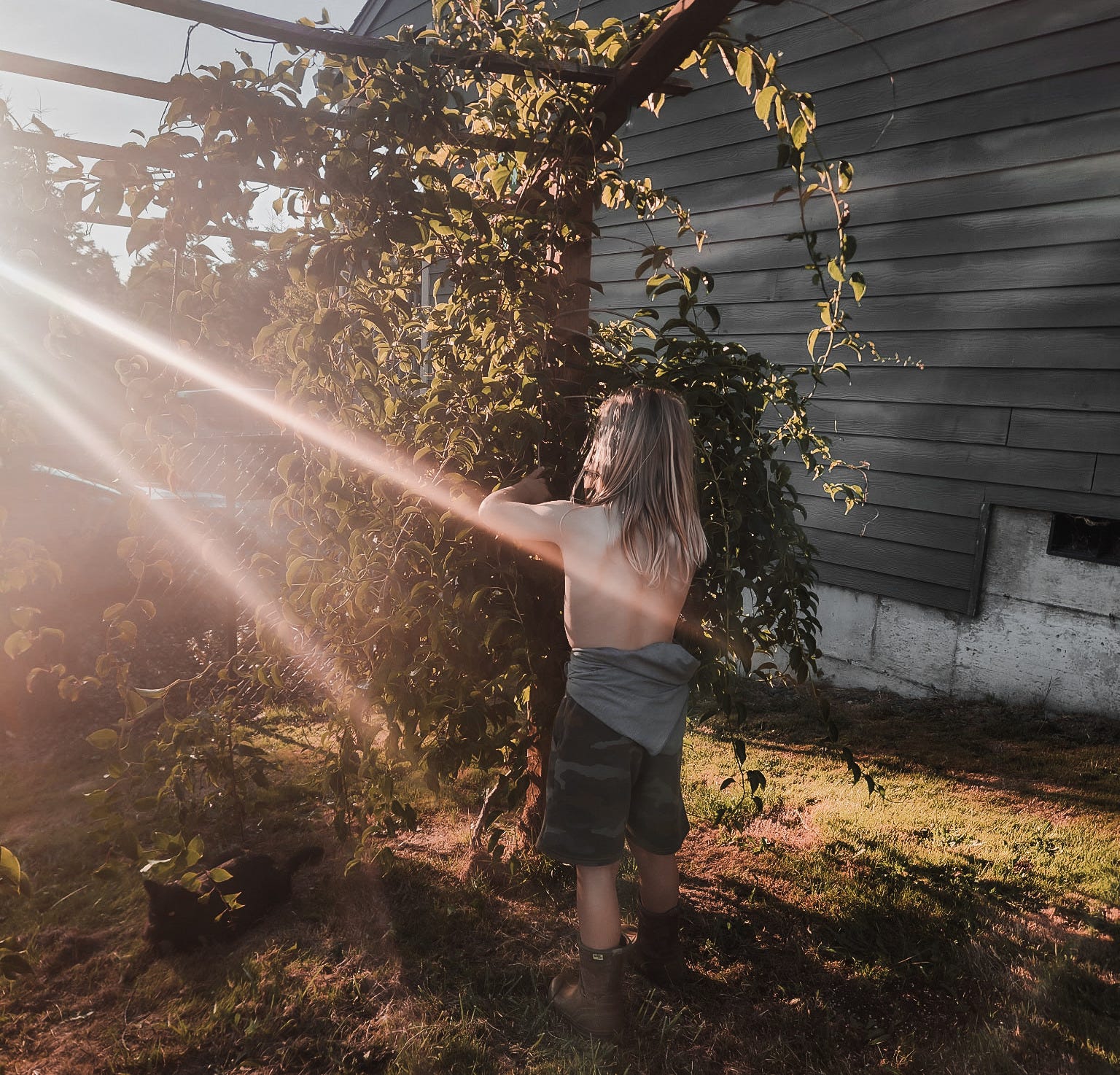
I’m back in the peaceful quiet zone while his soft murmurs join my hands in their quiet, deft work. The vines of the kiwi have gone unruly. Hands unraveling hundreds of exuberant, green snakes, twining around one another, in need of new support.
That’s the feeling I have while softly untangling the delicate, bright green vines from the new growth they’ve wrapped around. This plant is full of energetic, unbridled, child-like joy.
Once again, a voice catches my attention.
“Mama, do you think this is wick?” My stomach dips, a little flutter like the wings of the painted ladies who visit this garden. This child, who I have to all but drag to listen to read aloud some days, just asked me if a branch was wick?1
“I’m not sure. Why don’t you trim it and find out?” He correctly identifies the brown bits with no green ends.
Now the whispering of “wick,” “yup, wick,” “wick, I guessed it,” accompanies my gentle work. How can someone be so incredibly innocent and effortlessly wise at the same time? I think we all are at the core. We’ve just forgotten how.
“What does wick mean?” asked Mary.
“It means ‘alive’ or ‘lively,’” answered Dickon. “It’s as wick as you or me…
“I'm glad it's wick!" she cried. "I want them all to be wick. Let us go round the garden and count how many wick ones there are." The Secret Garden—Frances Hodgson Burnett
I let myself drift deeper into my biodelic state. Sunset, a liminal time, lulls us into the in-between. Sensory gates open, like those leading into the garden, and I experience the otherworldly quality of natural time. My feet are still on green grass, a rare treat for early July. The breeze is soft, while the orange ball in the summer sky dips beyond the forest to the west. I feel so light and radiant, minding these vines. My eight-year-old is matching the mood of the plants, and the three of us entwine as we unwind the vines.
My husband is drawn into our orbit, catching us towards the end of our task. He asks me if I like un-weaving as much as weaving.
I think he likes me as a witch.
Now, I am no longer weaving with vines; it’s hair, threads, and fates.
This is the ideal state to be braiding futures in. Heart open, womb and feet connected to the Earth, innocence and wisdom wrapped around you.
As much as I’m untangling, there’s a simultaneous reweaving alongside.
It’s peaceful, beautiful summer nights. Berry-stained cheeks that won’t last forever. Sweet little voices that watch over plants, and lips that purse to hide the smirk when they receive praise.
It’s true delight to be kiwi.
My deeper dive in to what The Secret Garden has meant to me.
Healing the Mother Wound

Wander with me down a rabbit trail, into the Secret Garden as source for looking at our mother wounds differently. In the garden our orientation isn’t healing. It returns us to a relationship with life that nourishes us so deeply, the wound is no longer where we live from. Nature soothes the wound of neglect. In her we find the original Mother. The way …
"Wick" is a Yorkshire dialect word meaning "alive" or "lively," introduced to Mary by Dickon in The Secret Garden.